The first day Linda and I walked up Center Street in Statesville in 1971, we passed by a Confederate statue standing tall on the courthouse lawn. I had a job with a paving company which transferred me from Belmont to Statesville. Because we were newlyweds coming to Statesville to make our home, we were full of positivity and joy in anticipation of what might be in front of us. Linda had been raised in Wilson NC and I had been a child of Gastonia. Statesville seemed the perfect place for us; The same sized town we were both raised in, far enough away from our families but close enough to get to them quickly. That was 53 years ago. I have never forgotten the feeling I had when we realized that we had committed to a town that had embraced the memory of enslavers and the possibility that the “lost cause” was not lost in Statesville. We would get through it…..
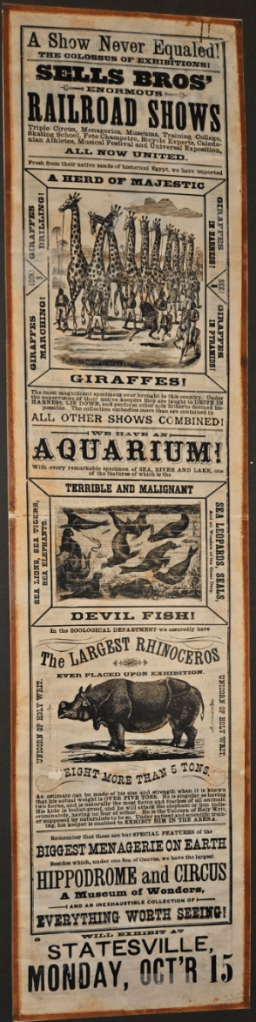
It was in October of 1883 that a circus came to town. It was held where presently the old depot is located near to the New Victory Baptist Church between the railroad tracks and Monroe Street.
From the Statesville Record 10/19/1883
Sells Brothers Circus
“After several weeks of through advertising through this and adjoining counties, the circus exhibited here last Monday. A tremendous crowd gathered under the canvas – the largest ever seen on a similar occasion in Statesville. There were probably from 6000 to 7000 persons present; at all events there were about as many as could be comfortably seated. The menagerie is not an extensive one, but there were a number of new and several very interesting specimens. The circus performance was very good indeed – quite up to and probably something above the average. It was not as good as Mayberry, Pullman and Hamilton’s circus which was here last fall, but better than S,H, Barrett’s. The contortionists were excellent; the tumbling very fine. Master Willie Sells riding was first rate; that of the other male riders indifferent; that of Miss Viola Rivers very bad. The dog show was capital; the trapeze performance not noteworthy and the bicycle riding tip top – the feature of the exhibition. The clowns were very funny in their acting, though they got off no new witticisms and sang no new songs. The circus as a whole pleased the people, and that is what it was for.”
The story of that week and what followed in Statesville is not all factual. There were newspapers which were extremely racist and some were not so much. Conjecture, in this case is essential if any story is to be told at all. Subjectivity is impossible to avoid as objective analysis of the facts is unreachable. Interpreting stories told in the past must be done according to the demands of the present; redrafting the story makes sense in order to establish where we are in the current moment.
This story is to be somewhat akin to moving to an old, abandoned farm in the country and finding a car manufactured long ago out behind the barn.
Parts are scattered all over the place and many are missing. Parts of parts lie partially buried and some will never be found. The seats cushions and floor are worn and rotten beyond repair. Grass has grown up and even some scrub trees might now be integral to the vehicle. In fact, the car has become part of a tree as the tree grew stronger and the car became more dilapidated.
I will be trying to get this car out of the weeds, running again, all the while putting together these myriad pieces while trying to figure out what they were used for and why they were there. I think I will probably have to gather some remanufactured parts, but I will try to keep it as original as possible.
This story is formatted by using the newspaper clippings from the time of the events. After each clipping or set of clippings, I will try to interpret and provide commentary and some analysis as to how and why it happened and what we might learn. So, here we go…
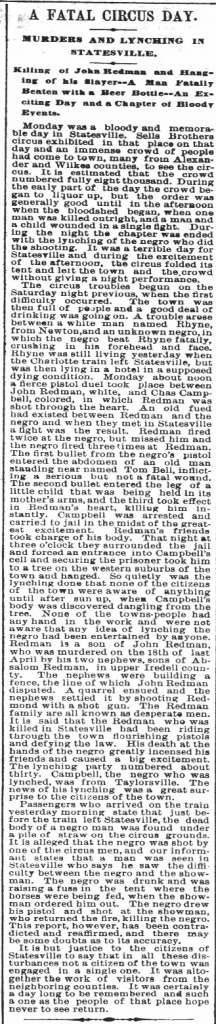
Wednesday Oct 17 1883 Charlotte Observer
“A Fatal Circus Day”
Murders and Lynching in Statesville
Killing of John Redman and hanging of the Slayer— A man fatally beaten with a beer bottle—An Exciting Day and a Chapter of Bloody Events
Monday (Oct 15) was a bloody and memorable day in Statesville. Sells Brothers Circus exhibited in that place on that day and an immense crowd of people had come to town, many from Alexander and Wilkes Counties to see the circus. It is estimated that the crowd numbered fully eight thousand. During the early part of the day the crowd began to liquor up, but the crowd was generally good until in the afternoon when the bloodshed began, when one man was killed outright and a man and a child wounded in a single fight. During the night the chapter was ended with the lynching of the negro who did the shooting. It was a terrible day for Statesville and during the excitement of the afternoon, the circus folded its tent and left the town without giving a night performance
The circus troubles began on the Saturday night (October 13) previous when the first difficulty occurred. The town was then full of people and a good deal of drinking was going on. A trouble arose between a white man named Rhyne from Newton and an unknown negro in which the negro beat Rhyne fatally, crushing his forehead and face. Rhyne was still living yesterday (October 16) when the Charlotte train left Statesville, but was then lying is a hotel in a supposed dying condition. Monday about noon a fierce pistol duel took place between John Redman, white and Chas Campbell, colored in which Redman was shot through the heart. An old feud had existed between Redman and the negro and when they met in Statesville, a fight was the result. Redman fired twice at the negro but missed him and the negro fired three times at Redman. The first bullet from the negro’s pistol entered the abdomen of an old man standing near named Tom Bell, inflicting a serious but not fatal wound. The second bullet entered the leg of a little child that was being held in its mother’s arms, and the third took effect in Redman’s heart, killing him instantly. Campbell was arrested and carried to jail in the midst of the greatest excitement. Redman’s friends took care of his body. That night at 3 o’clock they surrounded the jail and forced an entrance into Campbell’s cell and securing the prisoner, took him to a tree on the western suburbs if the town and hanged. So quietly was the lynching done that none of the citizens of the town were aware of anything until after sunup when Campbell’s body was discovered dangling from the tree. None of the townspeople had any hand in the work and were not aware that any idea of lynching the negro had been entertained by anyone. Redman is the son of John Redman, who was murdered on the 18th of last April by his two nephews, sons of Absolom Redman in upper Iredell County. The nephews were building a fence, the line of which John Redman disputed. A quarrel ensued and the nephews settled it by shooting Redman with a shotgun. The Redman family are all known as desperate men. It is said that the Redman who was killed in Statesville had been riding through town flourishing pistols and defying the law. His death at the hands of the negro greatly incensed his friends and caused a big excitement. The lynching party numbered about thirty. Campbell, the negro who was lynched was from Taylorsville. The news of his lynching was a great surprise to the citizens of the town.
Passengers who arrived on the train yesterday morning state that just before the train left Statesville, the body of a negro man was found under a pile of straw on the circus grounds. It is alleged that the negro was shot by one of the circus men and our informant states that a man who was seen in Statesville who says he saw the difficulty between the negro and the showman. The negro was drunk and was raising a fuss in the tent where the horses were being fed when the showman ordered him out. The negro drew his pistol and shot at the showman, who returned the fire, killing the negro. This report, however has been contradicted and reaffirmed and there may be some doubts as to its accuracy.
But it is justice to the citizens of Statesville to say that in all these disturbances not a citizen of the town was engaged in a single one. It was altogether the work of visitors from the neighboring counties. It was certainly a day long to be remembered and such a one as the people of that place hope never to see return.
The Charlotte Observer was and still is a daily paper. It would be 5 more days before any local stories are published. A lot went on in that time span. The Observer did not have a reporter “on scene” and so had to rely on the stories of locals who might have been there (possibly drunk) and to secondary sources who might have been collecting info from various individuals including bystanders, politicians, community leaders, local reporters and others. All had their own perspective of what should and should not be said out loud. The article clearly exonerates the citizens of Statesville, placing the blame on outsiders. It also places a lot of blame on the Redman family from whom one of our recent sheriffs was descendent. Phil Redman was a great sheriff in that he played a part in solving many crimes. I actually helped him when he was a lieutenant in the department by some clever (a little bragging here) investigation techniques.
Linda and I were building a house in East Iredell and had a stained-glass window we intended to use in our bathroom. It was stolen from the site. I polled our neighbors to ask if they had seen anyone suspicious driving around. One of them said he saw a blue Pontiac Firebird with a big eagle on the hood slowly driving through. He wrote down the license plate as some elderly and fearful people are prone to do. A lawyer friend of mine after hearing what I said told me he might be able to get the identity of the owner for me. He did just that and I figured out a way to go to the house and introduce myself. I used to be a tree surgeon and so I found some of my old business cards and went to his door asking if they wanted some tree work done. When the lady opened the door I spotted the stain glass window which had been stolen leaning against the couch in their living room. I gave them a high price for the tree work and left after they said it was too much to pay. I then called the sheriffs department with the news of what I had found. Lt. Phil took over the investigation and discovered that these people had a ring of house breakers who were regularly stealing from construction sites. He was credited with solving the crimes and many arrests were made. He later ran for sheriff and won. He was and still is an upright citizen and servant of our county. This brings to mind that there are many prominent families still in Statesville who are related to the perpetrators of this lynching. There are many who worked with the black community to make sure the situation did not get out of hand. Part of that effort was to minimize the discussion as time passed. The lynching act was despicable and no one in their right mind would want to associate themselves or their families with the incident.
I write this in the spirit of our vision adopted by our ICRP group to build bridges, not to lay blame. It goes as follows:
“The Iredell Community Remembrance Project will research evidence-based facts to establish truth. We will build relationships and coalitions in order to heal. We will encourage advocacy and present narrative to reconcile and foster harmonious coexistence in our community.”
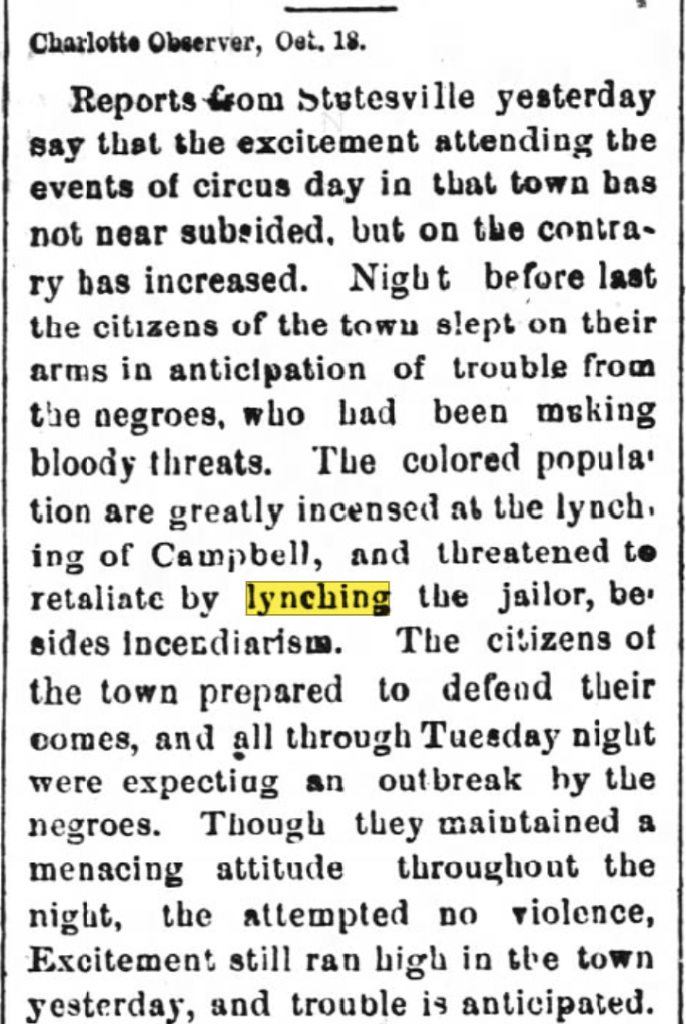
October 18th Charlotte Observer
“Reports From Statesville yesterday say that the excitement attending the events of circus day in that town has not near subsided, but on the contrary, has increased. Night before last he citizens of the town slept on their arms in anticipation of trouble from the negroes who had been making bloody threats. The colored population are greatly incensed at the lynching of Campbell and threatened to retaliate by lynching the jailer, besides incendiarism. The citizens of the town prepared to defend their homes and all through Tuesday night were expecting an outbreak by the negroes. Though they maintained a menacing attitude throughout the night, they attempted no violence. Excitement still ran high in the town yesterday, and trouble is anticipated.”
This clip states clearly the actual fear the citizens of our town felt that week. “Sleeping on their arms”, violence and menacing are words not to be ignored. The threat was perceived to be real, but the fear itself is something that had to be reconciled. The leaders of our community honestly dealt with the situation with intelligence and a good spirit as you will see.
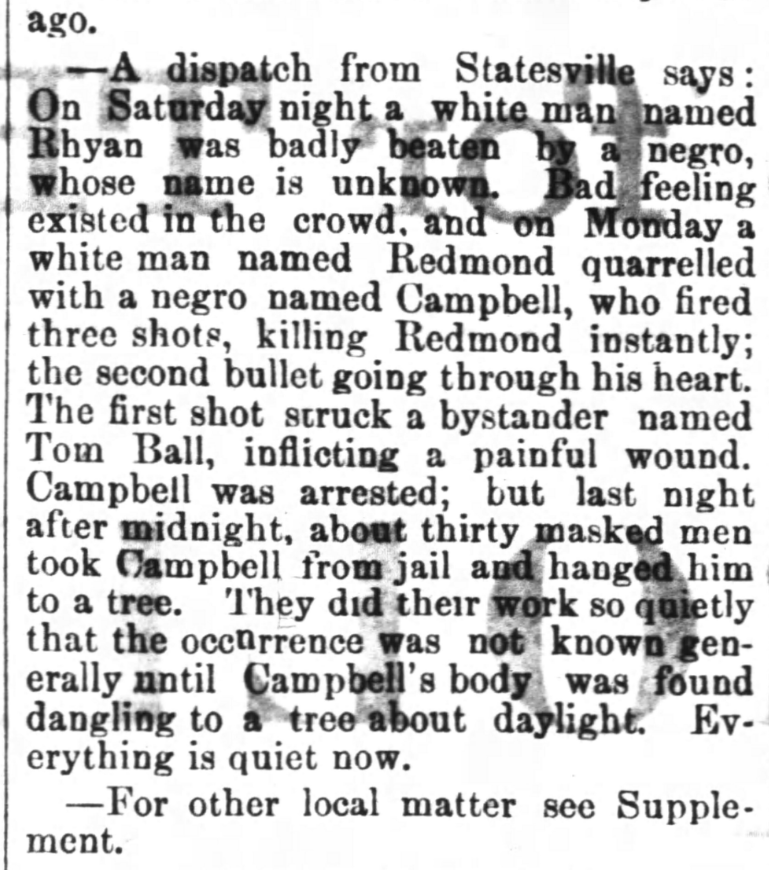
Goldsboro paper Oct 18 1883
“A dispatch from Statesville says: On Saturday night a white man named Rhyan was badly beaten by a negro, whose name is unknown. Bad feeling existed in the crowd and on Monday a white man named Redmond quarreled with a negro named Campbell, who fired three shots, killing Redmond instantly; the second bullet going through his heart. The first shot struck a bystander named Tom Ball, inflicting a painful wound. Campbell was arrested; but last night after midnight about 30 masked men took Campbell from jail and hanged him to a tree. They did their work so quietly that the occurrence was not known generally until Campbell’s body was found dangling to a tree about daylight. Everything is quiet now.”
This dispatch was probably verbal or second hand as two of the names were misspelled. Also things were not so quiet.
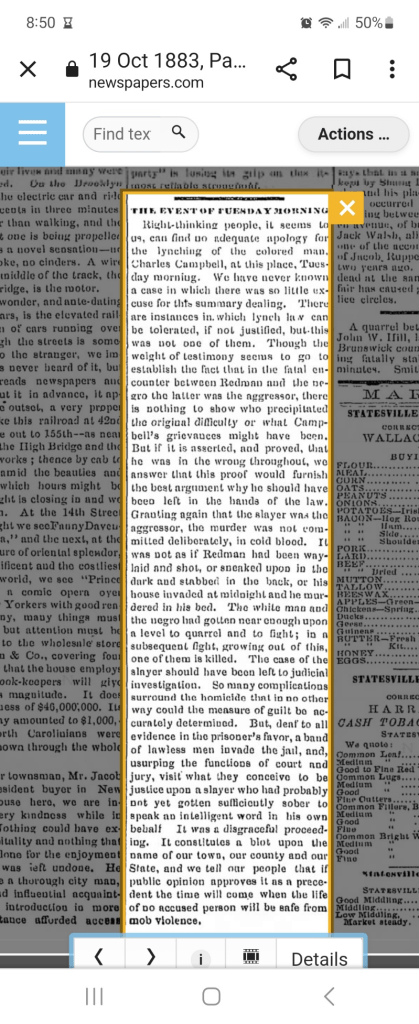
October 19th 1883 Statesville Record “The Event of Tuesday Morning
Right thinking people, it seems to us can find no adequate apology for the lynching of the colored man, Charles Campbell at this place Tuesday morning. We have never known a case where there was so little excuse for this summary dealing. There are cases where lynch law can be tolerated, if not justified, but this was not one of them. Though the weight of testimony seems to go to establish the fact that in the fatal encounter between Redman and the negro, the latter was the aggressor, there is nothing to show who precipitated the original difficulty or what Cambell’s grievances might have been. But if it is asserted and proved that he was in the wrong throughout, we answer that this proof would furnish the best argument why he should have been left in the hands of the law. Granting again that the slayer was the aggressor, the murder was not committed deliberately in cold blood. It was not as if Redmond had been waylaid and shot or sneaked upon in the dark and stabbed in the back or his house invaded at midnight, and he murdered in his bed. The white man and the negro had gotten near enough upon a level to quarrel and to fight; in a subsequent fight growing out of this, one of them is killed. The case of the slayer should have been left to judicial investigation. So many complications surround the homicide that in no other way could the measure of guilt be accurately determined. But, deaf to all evidence in the prisoner’s favor, a band of lawless men invade the jail and usurping the functions of court and jury visit what they conceive to be justice upon a slayer who had probably not yet gotten sufficiently sober to speak an intelligent word on his own behalf. It was a disgraceful proceeding. It constitutes a blot on the name of our town, our county and our state, and we tell our people that if public opinion approves it as a precedent the time will come when no accused person will be safe from mob violence.”
What a great way to put out the news. The Statesville Record’s publisher was a man named Joseph P Caldwell. I expect that he had a lot to do with writing this. He shows leadership, fortitude and compassion in what he says. He also avoids any positive comments on the lynching and condemns it for what it is. Thank God he was present in our town. Things could have gotten much worse if he had not stepped up. He was one of the “Right thinking people.”
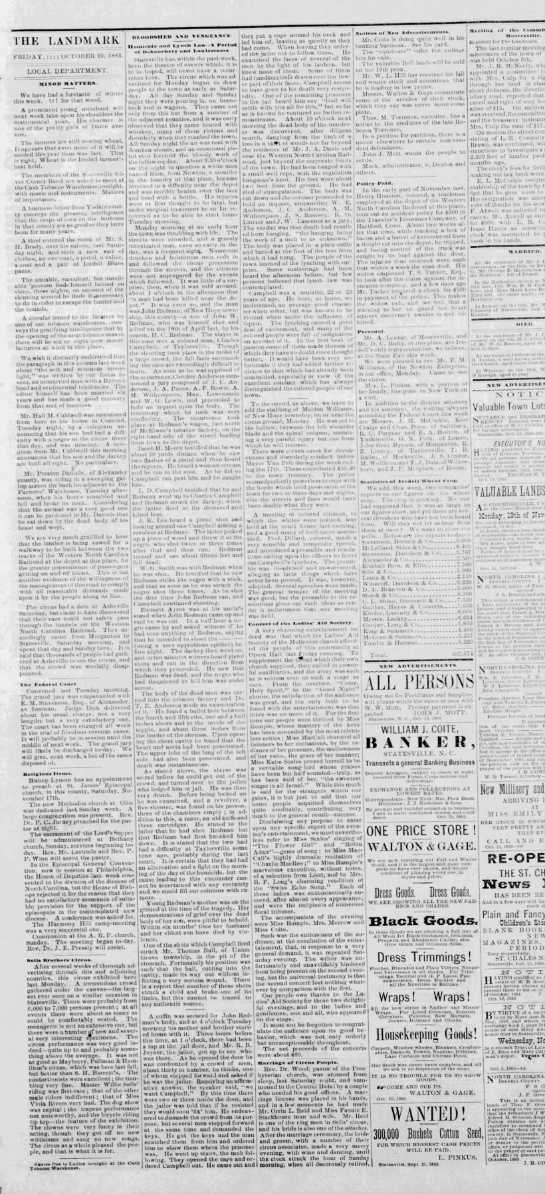
Oct 19th 1883 Statesville Landmark
“Bloodshed and Vengeance
Homicide and Lynch Law – A period of Debauchery and Lawlessness. Statesville has, within the past week, been the theater of events which, it is to be hoped, will never have a recurrence here. The circus which was advertised for Monday began to draw people to the town as early as Saturday. All day Sunday and Sunday night they were pouring in on horseback and in wagons. They came not only from this, but from a number of adjacent counties, and it was early observed that they came heated with whiskey, many of them riotous and disorderly when they reached the town.
All Sunday night the air was rent with drunken shouts and an occasional pistol shot foretold the bloody work of the following day. About 9:30 o’clock on the night in question a white man, named Kinn from Newton, a moulder (sic) in the foundry at that place became involved in a difficulty near the depot and was terribly beaten over the face and head with a bottle. His injuries were first thought to be fatal, but under surgical treatment he so far recovered so as to be able to start home Tuesday morning.
Monday morning at an early hour the town was throbbing with life. The streets were crowded and a grossly intoxicated man, even so early in the day was a frequent site, Numerous drunken and boisterous men rode in and followed the circus procession through the streets and the citizens were not unprepared for the events which followed. It was little of a surprise then when it was told around about 1 o’clock in the afternoon that “a man had been killed near the depot”. It was even so and the man was John Redman, of New Hope township of this county, the son of John W Redman, who was himself shot and killed on the 18th of April last by his cousin HC Redman. The slayer in this case was a colored man, Charles Campbell of Taylorsville. Though this shooting took place in the midst of a large crowd, the full facts surrounding the case are exceedingly difficult to learn. As soon as he was appraised of the occurrence, Coroner Anderson summoned a jury composed of JC Anderson, JA Pierce, AF Bowie, AM Witherspoon, Max Lowenstein and WG Lewis, and proceeded to hold an inquest upon the body. The testimony he took was very conflicting. The occurrence took place at Redman’s wagon just north of McElwee’s tobacco factory on the right hand side of the street leading from town to the depot. (This would have been behind the current location of the Alamo Bar.)
Jacob H Moore testified that he was about 50 yards distant when he saw two flashes of a pistol and then heard the reports. He heard a woman scream and he ran to the spot. As he did so, Campbell ran past him and he caught him.
L D Campbell testified that he and Redman went up to Charles Campbell and Redman struck the darkey, when the latter fired at the deceased and killed him. JK Lee heard a pistol shot and looking around saw Campbell aiming a revolver at Redman. The latter picked up a piece of wood and threw it at the negro, who shot twice or three times after that and then ran. Redman turned and ran about 15 feet and fell dead.
WG Smith was with Redman when he was shot. He testified that he saw Redman strike the negro with a stick and as soon as he was struck, the negro shot three times. As he shot the first time, John Redman ran and Campbell continued shooting.
Emmett Ayres was at his uncle’s stand when John Redman came up and said he was cut. In a half hour a negro came by and asked witness if he had seen anything of Redman, saying he intended to shoot the _______ ________ (using a very opprobrious epitaph) before night. The darkey then went on, and in 10 minutes witnesses heard pistol shots and ran in the direction from which they proceeded. He saw that Redman was dead and that the negro who had threatened to kill him was under arrest.
The body of the dead man was carried into the tobacco factory and Dr TE Anderson made an examination of it. He found a bullet hole between the 4th and 5th ribs 1.5” above and to the inside of the nipple and about 3” from the border of the sternum. Upon opening the chest cavity, he found that the heart and the aorta had been penetrated. The upper lobe of the lung of the left side had also been penetrated and death was instantaneous. As stated above the slayer was seized before he could get out of the crowd and turned over to the police who lodged him in jail. He was then very drunk. Before being locked up, he was examined and a revolver, a 5 shooter was found on his person; three of the chambers empty; and in addition to this, a razor, an old knife and three cartridges. He stated to the jailer that he had shot Redman but that Redman had first knocked him down. It is stated that the two had had a difficulty at Taylorsville some time ago, probably during the last court. It is certain that they had had an altercation and a fight on the morning of the day of the homicide, but the cause leading to this encounter cannot be ascertained with any certainty and we could fill or columns with rumors.
Young Redman’s mother was on the ground of the tragedy. Her demonstrations of grief over the dead body of her son were pitiful to behold. Within 6 months’ time, her husband and oldest son have died by violence.
One of the shots which Campbell fired struck Mr Thomas Ball of Union Grove township in the pit of the stomach. Fortunately his position was such that the ball cutting into the cavity made its way out without inflicting a very serious wound. There is a report that another of those shots struck a child and broke one of its limbs, but this cannot be traced to any authentic source.
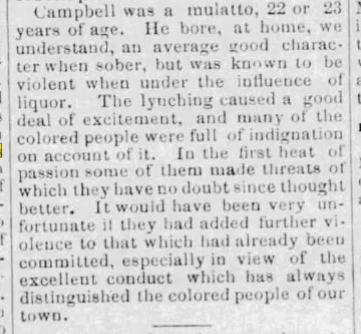
A coffin was secured for John Redman’s body and at 4 o’clock Tuesday morning his mother and brother started home with it. Three hours before this time at 1 o’clock there had been a tap at the jail door, and Mr RB Joyner, the jailer got up to see who was there. As he opened the door he was confronted by a crowd of men, about thirty in number, he thinks, one of who stepped forward and asked if he was the jailer. Receiving an affirmative answer, the speaker said “We want Campbell”. By this time there were two or three inside the door, and the jailer was told that if he resisted, they would soon ‘fix’ him. He endeavored to dissuade the crowd from its purpose, but several men stepped forward at the same time and demanded the keys. He got the keys and the man snatched them from him and ordered him to show them where the prisoner was. He went upstairs, the mob following. They opened the cage and ordered Campbell out. He came out and they put a rope around his neck and led him off, leaving as quietly as they had come. When leaving, they ordered the jailer not to follow them. he examined the faces of the men by the light of his lantern, but knew none of them. Some of them had handkerchiefs drawn over the lower part of their faces. Campbell seems to have gone to his death very resignedly. One of the remaining prisoners in the jail heard him say “God will settle with you all for this” but so far as is known, he ventured no further remonstrance. About 10 o’clock next morning the dead body of the murderer was discovered after a diligent search hanging from the limb of a tree in a skirt of woods not far from the residence of Mr JA Davis and near the Western NC Railroad, just beyond the corporate limits of the town. He had been hanged with a small well rope with a regulation hangman’s knot. His feet were about two feet from the ground. He had died of strangulation. The body was cut down and the coroner proceeded to hold an inquest, empaneling WE Anderson, JC Anderson, AM Witherspoon, JS Ramsey, RO Linster, and JW Laurence as a jury. The verdict was that death had resulted from hanging. “the hanging being the work of a mob to us unknown”. The body was placed in a plain coffin and buried at the foot of the tree from which it had hung. The people learned of the lynching with surprise. Some mutterings had been heard the afternoon before, but few believed that lynch law was contemplated. Campbell was a mulatto, 22 or 23 years of age He bore, at home, we understand an average good character when sober, but was known to be violent when under the influence of liquor. The lynching caused a good deal of excitement and many of the colored people were full of indignation on account of it. In the first heat of passion, some of them made threats of which they have no doubt thought better. It would have been very unfortunate if they had added further violence to that which had already been committed, especially in view of the excellent conduct which has always distinguished the colored people of our town.
To the record as above, we have to add the stabbing of Maldon Williams of New Hope township on or near the circus ground, Monday. He was cut to the hollow between the shoulder blade and the spinal column sustaining a very painful injury but one from which he will recover.
There were eleven cases for drunkenness and disorderly conduct before Mayor Van Pelt during the week ending the 17th. These contributed $50.40 to the town treasury. The police seemed perfectly powerless to cope with the horde which held possession of the town for two or three days and nights else the arrests and fines would have been double what they were.
A meeting of colored citizens, to which the white were invited, was held at the court house last evening and a good many of both races attended. Prof. Dillard, colored made a very sensible and temperate speech, and introduced a preamble and resolutions calling upon the officers to ferret out Campbell’s lynchers. The preamble was ill-advised and unwarranted, alleging as facts things which have never been proved. It was, however, adopted. Several speeches were made. The general temper of the meeting was good, but the preamble to the resolutions gives out such ideas as render it unfortunate that any meeting was held.”
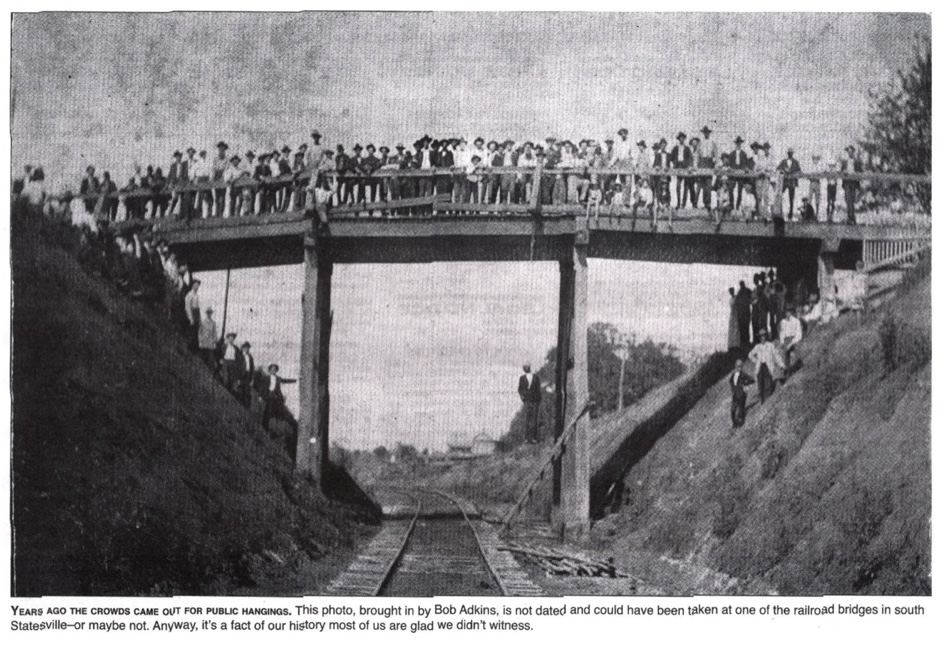
E.G. & J. Mallard were the publishers of this paper. They merged with the Landmark in the 1960s. There is more than a condescending attitude in this article than is in most of the others. It actually bemoans the fact that the meeting should have been held at all, allowing an excuse for what happened. It does lay out the location of the lynching and led us to coordinate the three points to identify where this evil deed was carried out. After the hanging of Tom Dooley (Dula) years prior, at the courthouse, the public hangings were moved to a location called “The Hanging Lot”. This lot was close to the intersection of Hill Street and Connor Street not far from the tracks. I suppose that the “right minded people” of our town did not like to see people of any color hanging from a gallows right smack in the center of town. All subsequent legal executions were held at that same place. There are some other documents that indicate that the body of Charles Campbell was not simply removed from the tree and placed in a casket at the foot of that tree. Our research indicates that it was displayed after the “word was spread” hanging from a bridge closer to the site of the circus so that a picture of the willing crowd and Charles Campbell could be staged. At that time, many lynching victims were photographed in order to sell postcards of the event. Setting up a photo shoot in those days was not done quickly as staging and equipment preparation took some time. It was the following Saturday when the body was made available for the brother of Charles to fetch the body and bury him in an unknown location is his home county of Alexander.
Charlotte Democrat October 19th 1883
“Circus Day in Statesville. On Monday was productive of more than unusual disorder, for the whiskey crowd indulged in numerous fights with fatal consequences. John Redman, a son of Mr. John Redman, who was murdered by his nephew last April, got into a difficulty with a negro man, named Campbell who killed Redman. Campbell was arrested and carried to jail. At night, Redman’s friends surrounded the jail and took the negro to the suburbs of town and hanged him. None of the citizens were aware of the lynching until the body was found the next morning. There were several fights, one white man was severely injured by a colored man and it is feared will prove fatal. The colored people are quite indignant at the lynching of Campbell and have threatened retaliation, and the excitement has caused the citizens to prepare for any attempt at violence.”
The two articles (Oct 19th) repeat some of the circumstances. They also express some comments on the black population in a backhanded manner. It reminds me of how even today the press uses circumstances to sell papers. We all have been exposed to the fear of running out of milk and bread when the winter sky gets cloudy and then have the situation actualize because of the fear that is spread.
OCTOBER 20th edition of the Statesville Landmark.
“THE MEETING THE NIGHT OF THE 18TH
We had time last week to make but brief references to the meeting which was held at the court house on the night preceding the day of our last issue. The proceedings of the day have been since been handed to us for publication. We would be entirely justifiable in withholding them since the meeting made no request that they be printed in this paper: we marked carefully at the time the wording of the last resolution as submitted to the meeting, and it was an instruction that the proceedings be sent to all the colored newspapers of the state. Nevertheless, for the gratification of a curiosity which exists in the community for the purpose of pointing out certain inaccuracies which can only be seen when the proceedings are published, and further still to afford opportunities for some comments, which seem to us to be pertinent, we give them place elsewhere in our columns.
It is not so much that the court house is represented as “crowded to the utmost capacity” — when in point of fact it was not half full; it is not so much as gentlemen who did not open their mouths are represented as making speeches—- not so much glaring inaccuracies as these are objected to, as the judicial like manner in which the preamble lays down as facts things which have not been proved and which cannot be proved. In one word the vital objection of the whole proceeding is that a public meeting should have assumed to lay before the public the facts in a knotty and complicated criminal case, and apportion to each, apparently with the greatest nicety the measure of guilt of the slayer and the slain. This preamble contravenes the facts adduced at the coroner’s request and recites as facts hitherto never heard of by persons who think they have been at some trouble to sift the case to the bottom. But that is not the thing. The error was in having undertaken to go into the facts as to the killing of Campbell. We conceive that that had nothing to do with the legitimate object of that meeting. If it had met and passed resolutions denouncing lynch-law in general and the lynching of Campbell in particular; if it had gone on and called, as it did, upon the officers of the law to vindicate the majority of that law by ferreting out and bringing to justice these lawless men, that would have been proper and right. But when a public meeting takes upon itself to try John Redman and find him guilty of an unprovoked and murderous attack upon Charles Campbell, whom it acquits of all blame, that is another thing. The real testimony is very conflicting; it has been impossible, thus far, to get at the full and actual facts; we have always suspected that the colored man had some reason for the furious passion that was upon him when he came upon the white man at the latter’s wagon; but that is not the point.
That upon which we insist is this: that if there is anything worse for the interests of society or for the cause of justice for lynch law, it is the holding of public meetings whether of white or colored men or both to render their verdict upon grave questions of law and facts in the absence of both law and evidence. The fact that both the parties to this difficulty were dead at the time of this meeting does not affect the merits of the proposition which we lay down. The next step in the direction which has been taken will be to hold a promiscuous court house meeting to pass upon the guilt or innocence of some party now in jail awaiting trial by the courts.
No man, white or colored, goes before us in the abhorrence of the crime by which Charles Campbell lost his life. By every consideration of justice and fair play he was entitled to have the facts in his case heard by a court and a jury. His taking off was barbarous – an act fit to be denounced – but sympathy in his behalf or against his lynchers is not to be excited by loose and unwarranted statements put forth by a thoughtless, promiscuous, irresponsible crowd.
This meeting lost sight of the legitimate object and overstepped the bounds within which it might properly have acted. Saying this we can still pardon much to the irritation of the moment, and as for our colored fellow citizens in general, we cordially commend them for their moderation which characterized their conduct and their speech, last week, when they were laboring under great excitement, born in what they felt to have been a grave outrage visited upon one of their race.”
Wow! He condemns the black population for making an effort to document the situation so as to preserve what happened to their community. The purpose of his article seems to promote impunity for the lynchers. It denies a lot of the postulates of the minutes of the meeting (see below) while ignoring the fear that had to have been present in the minds of the black folks attending. The fact that a meeting was held was a big step for them to have taken. It was to preserve justice. The author clearly does not understand the word, legitimacy. The white people attending were definitely not of that same mind. Surely, they were not attending for show, but to have their personal involvement serve to make sure that the townspeople know that we are all in this world together. It is noted here that the Statesville Landmark did not print the full minutes of the meeting in this issue or in any other issue. See the proceeding article from the Charlotte Observer.
Charlotte Observer October 21st 1883
“The Statesville Emeute (emeute means riot)
Public Meeting of the Colored People
Pursuant to a call of a number of leading colored men in Statesville, a public meeting was called at the court house Thursday morning Oct 14th to consider the recent lynching of Campbell and to denounce the report that a threat had been made by the colored people that they intended to burn the town in retaliation. Quite a number of white citizens were invited and took part In the proceedings.
We have been asked to publish the following synopsis of the proceedings as furnished by the Secretary.
At 8 o’clock PM the court house was crowded to its utmost capacity with both white and colored citizens in response to a call made by Rev JA Gosling, Richardson and other colored citizens.
On motion, Jordan Chambers, colored was elected chairman and Rev C Dillard, a graduate of Howard University, Washington DC was requested to act as Secretary.
The meeting having been called to order C Dillard as requested to state the object of the meeting.
He said that it was not the purpose of the colored citizens of Statesville to raise an insurrection or to even foster a desire of retaliation, but to inaugurate a plan by which the murderers of Chas Campbell, colored may be bought to suffer the full penalty of the law, and the colored citizens were spurred on in this matter through malice toward none, but by a sense of right, by a love for peace and for the maintenance of justice before the law. He asked that the wrong might be redressed through the law, and for the perpetrators of that brutal act be bought before a court of Iredell County and tried by judge and jury. Dillard then closed with a strong appeal to all lovers of the law, to both white and colored to unite in bringing the case to light and thus protect the good name of our community.
On motion, JF Van Pelt, the mayor of the town, was introduced to the audience, who in a speech united in the condemnation of the murderers of Chas Campbell. The mayor believed the lynchers to have been residents of the country (sic) and that Statesville being innocent should not be charged with the crime.
Dr JJ Mott, being called upon to address the meeting, endorsed the remarks of his predecessors.
He was followed by many of the white and colored citizens, viz: Lawyer Allison, Rev AS Billingsley, and Messrs. Gillespie, Caldwell, Richardson, Griffins and others.
C Dillard then offered the following resolutions, which after some discussion, were received and adopted.
Whereas, On last Monday,15th instant, while a large and promiscuous crowd, many of whom were intoxicated, had gathered to witness a circus, there occurred a difficulty between John Redman, a white man and Charles Campbell a colored man which resulted in the death of the former: and
Whereas, Competent and reliable witnesses are ready to testify that the white man was the aggressor, having attacked the colored man with a fence rail and was dealing him heavy and repeated blows; and
Whereas, The colored man was arrested and incarcerated in the jail of Iredell county, and on the night of October 15th, 1883, a body of men, without even being disguised, took said prisoner from the care and custody of the Sheriff of Iredell County, and the state of North Carolina, and without color of law, without trial by jury, that sacred right which the constitution of North Carolina guarantees to every man be him ever so humble – murdered him in a most inhuman and beastly manner; therefore.
Resolved, That is the sense of this meeting that we have assembled with malice to no man, but to humbly petition the solicitor and officers of justice to investigate and bring to justice the violators of law of decency and of the peace and well being of the state of North Carolina. We ask it in the name of justice, in the name of common decency and in the name of God. We call upon the white citizens of Statesville to witness the fact that as a race, we have been a law – abiding people and we appeal to you as honorable men, as representatives of the proud Anglo Saxon race, who glory in the fact that you have given mankind trial by jury to vindicate the good name and standing of our community.
Resolved, That a copy of these resolutions be given to Solicitor Adams and to the Judge who is to preside at the next term of the court and that a copy be sent to the leading newspapers of the state.
Resolved, That the thanks of this meeting are due and are hereby tendered to the Charlotte Observer for its fair and impartial report of this unfortunate occurrence.
The meeting then adjourned. Jordan Chambers, President C Dillard Secretary Statesville NC Oct. 19th 1883”
This lays it all out as they called for the murderers of Charles Campbell, who did the killing of Redman, be bought to legal justice. There was no need to bring up the guilt or innocence of anyone but the mob who lynched Campbell. Both Campbell and Redman were dead. These minutes were unfindable in any local publication as I suppose was what the black population assumed would happen. That is the very reason they sent the minutes to papers across the state, both black and white owned. They were pretty much ignored by the local law enforcement, the state law enforcement and the federal law enforcement. These circumstances are what the Jim Crow era was all about. Justice was called for and justice was not served. This is the core of the purpose of what we are trying to accomplish with our “Iredell Community Remembrance Project (ICRP). It has now been 142 years since this blemish on our town originated. The confederate statue on our courthouse lawn serves to memorialize this attitude. The blemish remains.
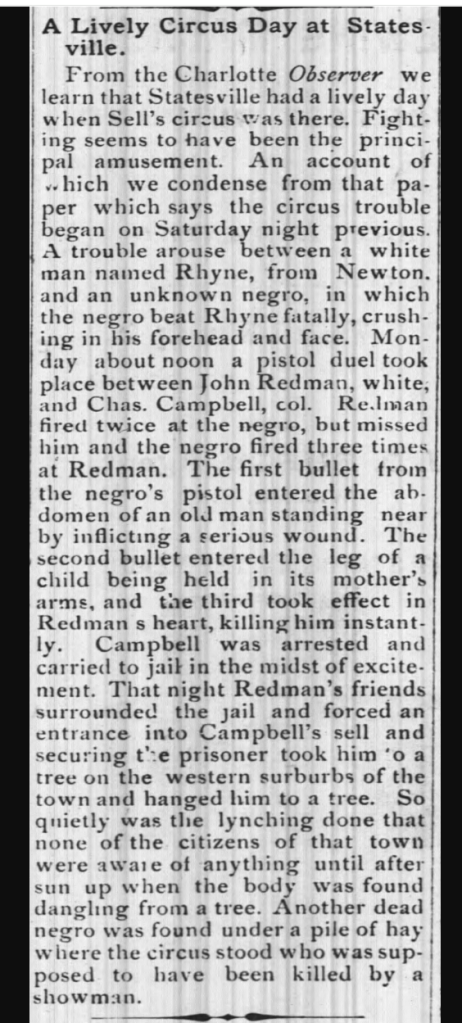
From The Winston Leader Oct 23 1883
“From the Charlotte Observer we learned that Statesville had a lively day when Sells Circus was there. Fighting seems to have been the principal amusement. An account of which we condense from that paper which says the circus trouble began on Saturday night previous. A trouble arouse between a white man named Rhyne from Newton and an unknown negro, in which the negro beat Rhyne fatally, crushing in his forehead and face. Monday about noon a pistol duel took place between John Redman, white, and Chas Campbell, col. Redman fired twice at the negro, but missed him and the negro fired three times at Redman. The first bullet from the negro’s pistol entered the abdomen of an old man standing near by inflicting a serious wound. The second bullet entered the leg of a child being held in its mother’s arms, and the third took effect in Redman’s heart, killing him instantly. Campbell was arrested and carried to jail in the midst of excitement. That night Redman’s friends surrounded the jail and forced an entrance into Campbell’s sell (sic) and securing the prisoner took him to a tree on the western suburbs of the town and hanged him to a tree. So quietly was the lynching done that none of the citizens of that town were aware of anything until after sun up when the body was found dangling from a tree. Another dead negro was found under a pile of hay where the circus stood who was supposed to have been killed by a showman.”
Campbell and Redman were not the only two killed that weekend. This article contradicts the local papers which stated there was no provocation on the part of Redman.
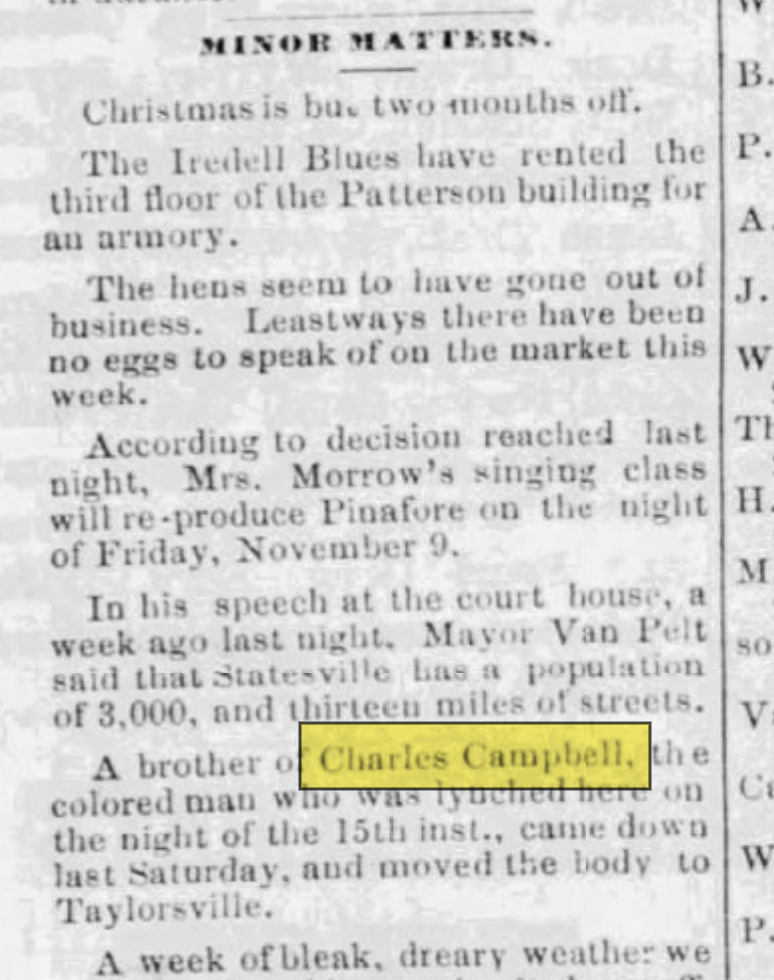
10/26 1883 Statesville Record
“In his speech at the court house a week ago last night Mayor Van Pelt said that Statesville has a population of 3000 and 13 miles of streets….
A brother of Charles Campbell, the colored man who was lynched here on the night of the 15th inst., came down last Saturday and moved the body to Taylorsville.”
These two excerpts are included to give the reader a sense of the size of Statesville at the time. Many articles indicate that there were up to 7000 visitors here for the circus in 1883 quadrupling the population for one week. That would be like having 100,000 people visiting the Balloon Rally. It also indicates that the body of Charles Campbell was available for the display at the bridge for several days.
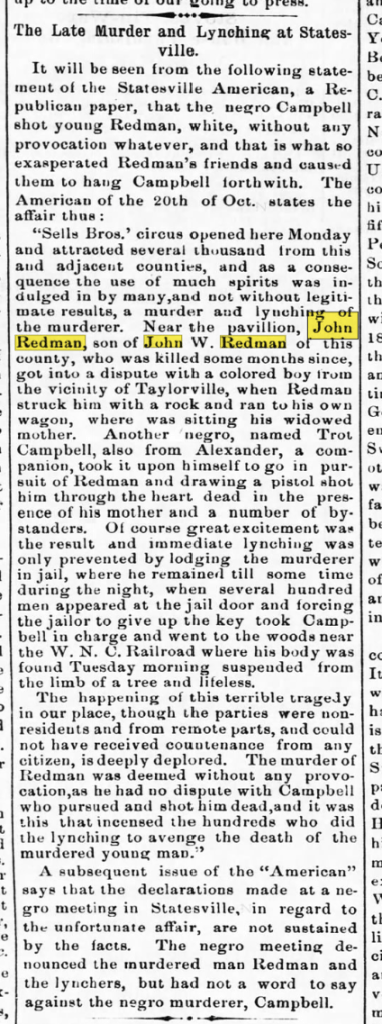
The Charlotte Democrat Nov 2nd 1883
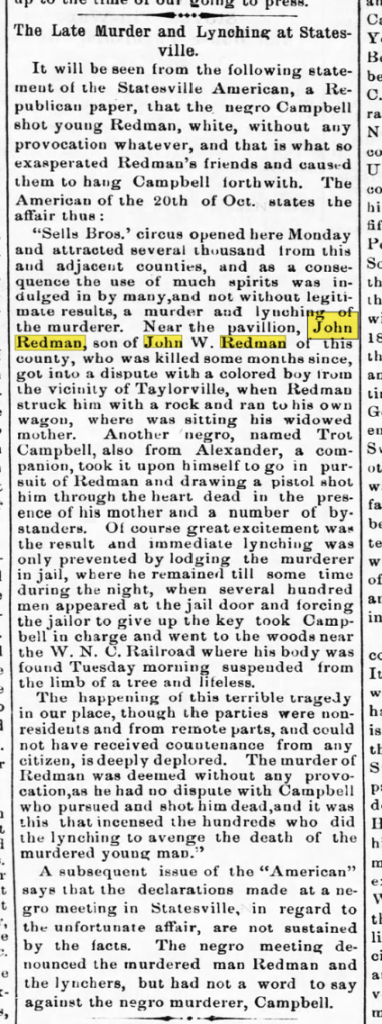
“The Late murder and Lynching at Statesville
It will be seen from the following statement of the Statesville American a Republican paper, that the negro Campbell shot young Redman, white, without any provocation whatsoever, and that is what so exasperated Redman’s friends and caused them to hang Campbell forthwith. The American of the 20th of October states the affair thus:
“Sells Bros’ Circus opened here Monday and attracted several thousand from this and adjacent counties, and as a consequence the use of much spirits was indulged in by many and not without legitimate results, a murder and lynching of the murderer. Near the pavilion, John Redman, son of John W Redman of this county who was killed some months since, got into a dispute with a colored boy from the vicinity of Taylorsville where Redman struck him with a rock and ran to his own wagon where was sitting his widowed mother. Another negro named Trott Campbell, also from Alexander, a companion took it upon himself to go in pursuit of Redman and drawing a pistol, shot him through the heart, dead in the presence of his mother and a number of bystanders. Of course, great excitement was the result and immediate lynching was only prevented by lodging the murderer in jail, where he remained till sometime during of the night when several hundred men appeared at the jail door and forcing the jailer to give up the key, took Campbell in charge and went to the woods near the WNC railroad where his body was found Tuesday morning suspended from a limb of a tree and lifeless.
The happening of this terrible tragedy in our place, though the parties were non-residents and from remote parts and could not have received countenance from any citizen and is deeply deplored. The murder of Redman was deemed without any provocation, as he had no dispute with Campbell who pursued and shot him dead, and it was this that incensed the hundreds who did the lynching to avenge the death of the murdered young man.”
A subsequent issue of the “American” says that the declarations made at a negro meeting in Statesville in regard to the unfortunate affair, are not sustained by the facts. The negro meeting denounced the murdered man, Redman and the lynchers, but had not a word to say about the murderer, Campbell.
It appears that the Democrats and Republicans were of one mind when it came to feelings about African Americans in 1883. The number of lynchers went from 30 to ”hundreds” in these publications. The tone of their reporting is obvious.
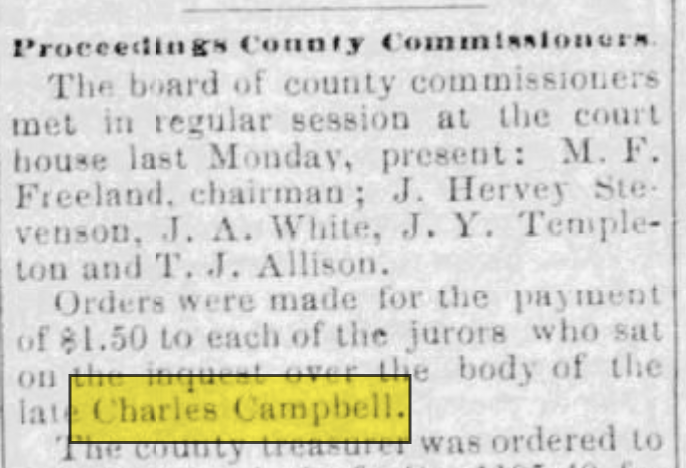
Friday 11/9/1883 Statesville Record
“Proceedings County Commissioners
The board of county commissioners met on regular session at the court house last Monday, present MF Freeland, Chairman; J Hervey Stevenson, JA White, JY Templeton, and TJ Allison. Orders were made for the payment of $1.50 to each of the jurors who sat on the inquest over the body of the late Charles Campbell.”
This refers to a county commission inquest over the body of Charles Campbell. I have been unable to locate any information on any inquest performed by the commissioners way back when. It is interesting to see some of the familiar surnames pop up in this article.
From the Iredell Citizen 6/29/2006 Pg 25
This picture was taken from the East change East to “South” side of the Elm Change Elm to “East Allison/Monroe” Street Bridge in Statesville most likely between Wednesday the 17th of October 1883 through Friday that same week. The depot and the gabled roof of the Statesville Flour Mill are seen clearly in the background in the exact position where they were located in 1883. We have pix from the Statesville Historical Museum which confirms the position and characteristics of the two buildings. There are also pictures of the current bridge taken from the same location in our file of backup docs. It most probably is a group gathered from the circus crowd to display (and to get a photo shoot of) the dead body of Charles Campbell. I expect that some of those people were participants in the lynching that week. The presence of children is astonishing. This photograph is extremely relevant in that it demonstrates the impunity of the 80 some participants and the willingness of so many people to be associated with the crime. We are still doing further investigation of the circumstances of this photograph. From the shadows the time of day can be calculated. The contour of the banks beside the bridge remain to this day. Since the ladder is in place, it can be assumed that it was used to lift the body up and not to take it down as he is still hanging there.
The Iredell Community Remembrance Project (ICRP) group is gathering more information and seeking to involve our current community in recognition of our past. It is not intended to honor or exonerate Cherles Campbell as he certainly did kill Redman
In the late 1800’s there were 3 documented lynchings in Iredell County. These events are memorialized at the Legacy Museum and Memorial in Montgomery Alabama. Researching the Raleigh N&O concerning the number of lynchings in NC we found:
“The answer: No one knows exactly how many, though researchers say it was at least 100 and possibly as many as 300 in the years from 1882 to 1968. The number of lynchings per year in Southern states spiked during the period from 1890 to 1920, the same period during which the most Confederate monuments were installed. Where the victims’ remains ended up is even more complicated.” 120 from NC are memorialized in Montgomery.
As you are aware, there is one of these confederate monuments standing tall on our old courthouse lawn. People who come to participate in our county government can’t help but notice.
An effort to counteract the impression that the statue presents to most of us and to visitors to Statesville is now underway. ICRP, composed of about half black and half white people is now building a coalition to counter that image left in the minds of residents and visitors alike. We are not opposed to the Daughters of the Confederacy memorializing their dead fathers, but want to weaken the attention it pays to the enslavement of so many Americans. A memorial sign placed in proximity to that statue will let visitors know that similar to the meeting of our racially mixed citizens in 1883, we respect the status of all. We do this acknowledging the interest of some who honor the plight of the soldiers who died for the “Lost Cause” while we let visitors know we are still a just and caring community.
We are continuing to weed through the reports of the day, hoping that you can add to this discussion. This is not to put Charles on a pedestal, but to acknowledge the awful circumstances of his illegal lynching that took place in our community in October 1883. Just as the horrors of the Civil War are memorialized, the continued aftermath should be recognized. We are proud of our community, and we want others to feel the same.
Credit for this compilation goes to Steve Hill at the wonderful Statesville Historic Museum, Joel Reese from the Iredell County Library, Ms Rosa Daniels of the Alexander Ancestry Association, Vicki Martin of the Alexander County Library, David Moton of Rutledge and Bingham Funeral Home, Bob Plyler (RIP) of the Iredell Citizen, Mia Taylor and Jennifer Harris of the EJI in Montgomery AL and the many participants involved in the ICRP



 Remembering the Past, Building a Just Future